

Astronomy & Cosmology Articles

Astronomy & Cosmology

Are we in Danger from a Local Interstellar Cloud Incursion?

The Local Interstellar Cloud

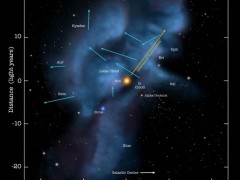
The solar system is currently embedded in the Local Interstellar Cloud, or Local Fluff as it is sometimes called, a gas cloud about 30 light years wide and travelling past us at 29 km per second. At this speed we should be going through it for the next 300,000 years. It has been suggested that this cloud may contain cloudlets having gas densities hundreds of times higher than the Local Interstellar Cloud average. How far away they may lie from the solar system or when they will impact us remains open to speculation. But, one might ask how likely it is that the solar system’s movement through such a high density region will affect the Sun and Earth, whether it will impact us in a way similar to how a superwave has done in the past?
Click to read more

Resurrection of the Hubble-Jeans Galaxy Formation Theory

Hubble-thumb

A review of the most recent data on galaxy evolution shows that the subquantum kinetics continuous creation theory of galaxy formation is correct. That galaxies progressively grow in size and mass, proceeding from dwarf elliptical to S0 to mature spiral and finally to giant elliptical. The data also call for the reinstatement of the galaxy evolution theory which Edwin Hubble and Sir James Jeans proposed in the early 20th century. It indicates that Hubble’s “tuning fork” diagram of galaxy evolution was largely correct with one exception. The elliptical galaxies on the left should be considered dwarf spheroidals and dwarf ellipticals while the giant elliptical category should be placed in a new branch to the right of the spirals, with both spiral category branches evolving into the giant elliptical category.

Click to read more

Letter to Physics Today magazine regarding subquantum kinetics galaxy redshift prediction

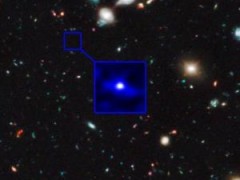
Hubble Ultra Deep Field 09.  Blue box shows z = 10 candidate galaxy.

Letter to the editor sent to Physics Today magazine on May 22, 1990 Will the Hubble Telescope Detect a Limit to Galaxy Redshifts? May 22, 1990 Paul A. LaViolette, Ph.D. The Starburst Foundation 2615 S.E. 111th Ave., #10 Portland, Oregon 97266   With the launching of the Hubble Space Telescope astronomers are anxiously waiting to see what will be revealed …
Click to read more

SQK Cosmology

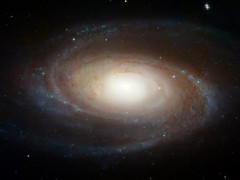
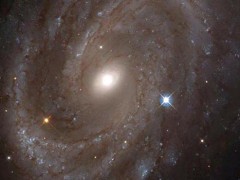
Hubble telescope image of M81(courtesy of NASA, ESA, and the Hubble Heritage Team)

Like other astrophysicists, Paul LaViolette once took the big bang theory on faith to be an accepted established fact. However, in 1978 he came to a juncture in which he had to know for sure whether the expanding universe hypothesis was really correct, or not. During the previous five years, he had been developing a unified field theory called subquantum kinetics whose aim was to explain the formation of material subatomic particles and by 1978 he had made an advance in this theory which indicated that for the theory to be correct photons would necessarily have to lose energy as they traveled through space, with this lost energy actually disappearing in a real sense from being present in the observable material universe.
Click to read more

Black Holes – Mother Stars

Gfield

In the physics of subquantum kinetics the Galactic core is referred to as the Galaxy’s mother star. According to subquantum kinetics, it does not exist in the form of a point singularity, but as a very dense supermassive star having a density similar to a neutron star or hyperon star. This conclusion is supported by the following observations and verifications:
Click to read more

Subquantum Kinetics Predictions

05-NGC4603

Superwave Theory Predictions and their Subsequent Verification in the fields of astronomy and physics
Click to read more

Galactic Superwaves and Core Explosions

11-gammabubbles

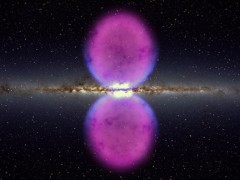
One principal area of research that the Starburst Foundation is involved with is the investigation of Galactic superwaves, intense cosmic ray particle barrages that travel to us from the center of our Galaxy and that can last for periods of up to several thousand years. Astronomical and geological evidence indicates that the last major superwave impacted our solar system around 12,000 to 16,000 years ago and produced abrupt changes of the Earth’s climate. It is estimated that approximately one or two superwaves strong enough to trigger an ice age are presently on their way to us from their birth place 23,000 light years away. There is a finite chance that one such event could arrive within the next few decades.
Click to read more

Galactic Cosmic Ray Volleys: A Coming Global Disaster

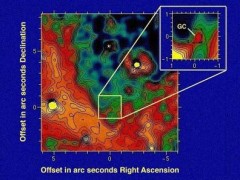
Figure 3. Infrared image of the Galactic center radio-emitting source Sagittarius A* seen at a wavelength of 8.7 microns (red spot marked as GC).  Taken with the Hale Telescope.  (Courtesy of Stolovy, Hayward, and Herter)

Galactic core outbursts are the most energetic phenomenon taking place in the universe. During the early 60′s astronomers began to realize that the massive object that forms the core of a spiral or giant elliptical galaxy periodically becomes active spewing out a fierce barrage of cosmic rays with a total energy output equal to hundreds of thousands of supernova explosions
Click to read more

  • Starburst Foundation Profile

    The Starburst Foundation is a nonprofit research institute based in Schenectady, New York and Athens, Greece.
    It was incorporated in the state of Oregon in January of 1984 for the purpose of carrying out scientific research and public education directed to the betterment of humanity and the planet. The Foundation’s research activities are carried out with the intention of:

    1. preserving and protecting the ecosystem of our planet from natural or man-made disturbances,
    2. promoting technologies that would improve our everyday life, and
    3. improving our understanding of ourselves as human beings and our comprehension of the universe of which we are an integral part.

    Starburst serves as a vehicle through which donors may support high-quality leading-edge research necessary to mankind’s survival in this new age.
  • Latest News

    Are we in Danger from a Local Interstellar Cloud Incursion?

    The solar system is currently embedded in the Local Interstellar Cloud, or Local Fluff as it is sometimes called, a gas cloud about 30 light years wide and travelling past us at 29 km per second. At this speed we should be going through it for the next 300,000 years. It has been suggested that this cloud may contain cloudlets having gas densities hundreds of times higher than the Local Interstellar Cloud average. How far away they may lie from the solar system or when they will impact us remains open to speculation. But, one might ask how likely it is that the solar system’s movement through such a high density region will affect the Sun and Earth, whether it will impact us in a way similar to how a superwave has done in the past?
    Click to read more